.png)

On Bastille's own website there's a review from an owner in Paris. He'd stopped cycling because his house has no garage and nowhere to keep a bike. Now he has a Bastille, which lives in his hallway, and he is delighted. Near the end of his write-up there's a five-word parenthesis: "(Je précise que je roule en ECO.)" I ride in Eco.
For two months I'd have told you that parenthesis was everything wrong with this bike. He rides in Eco because he lives in Paris, where the biggest hill most days is the Métro stairs. I live in Lisbon. I was wrong about the bike. It took a broken one to show me why.
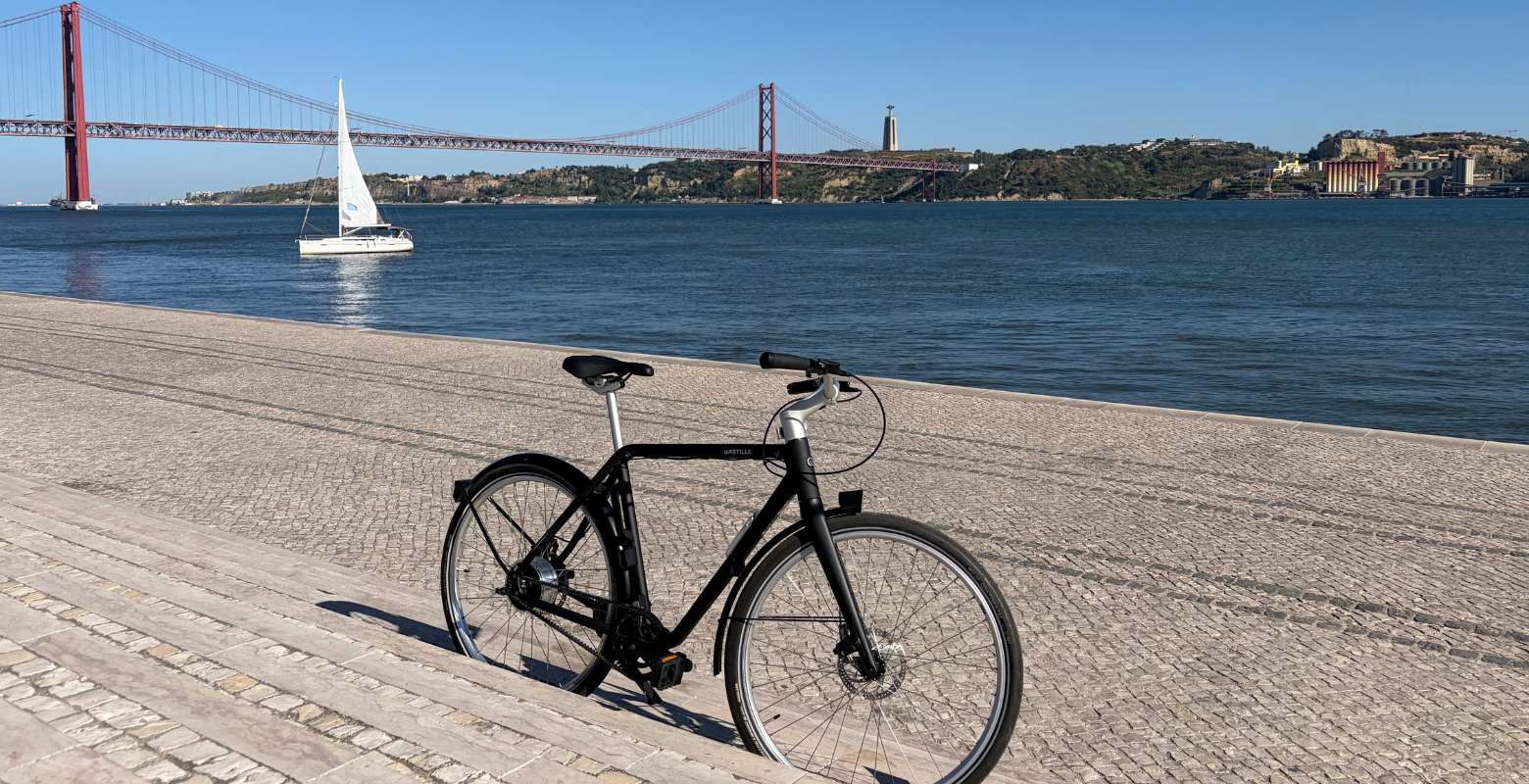
The Bastille E costs €3,190, or £2,790, and is assembled in France. It is a folding electric bicycle with full-size 27.5in wheels, which no other electric folding bike has managed. The Bastille, then, is the first ever full-sized folding electric bike. It folds to the footprint of a large suitcase in under ten seconds and then trails behind you like luggage, the handlebar doubling up as the thing you pull it along with. And it rides like a proper bike, too.
The man behind it is Gilles Henry, who designed the folding mechanism inside the Babyzen YOYO, the pushchair that goes in an overhead locker. He started on this bike in 2014, and over a decade and three patents later it comes down to four pivots set on four axes. Extend them, he says, and they ‘meet at a single point, a pyramid in space.’ Folded well, it collapses in ten seconds. There's a knack, and until you have it you'll be standing on a station platform with a half-folded bicycle in your arms, watching your train pull out. Four months in, I'm not sure I ever fully mastered it. Nuno Rocha, Bastille's representative in Portugal, makes it look effortless in the YouTube Short we've published alongside this review; my own attempts stayed a beat clumsier than his throughout.
At home I never fold it. It stands open in the hallway, and in four months, out and about, I have not once locked it to anything. Not outside a café, not at the office, not on the train, where it comes aboard with me. It isn't that the bike is hard to steal. It's that, because of the fold, it's never left anywhere to be stolen from. That is the marketing pitch, more or less, and it's the truest thing they say about the bike.
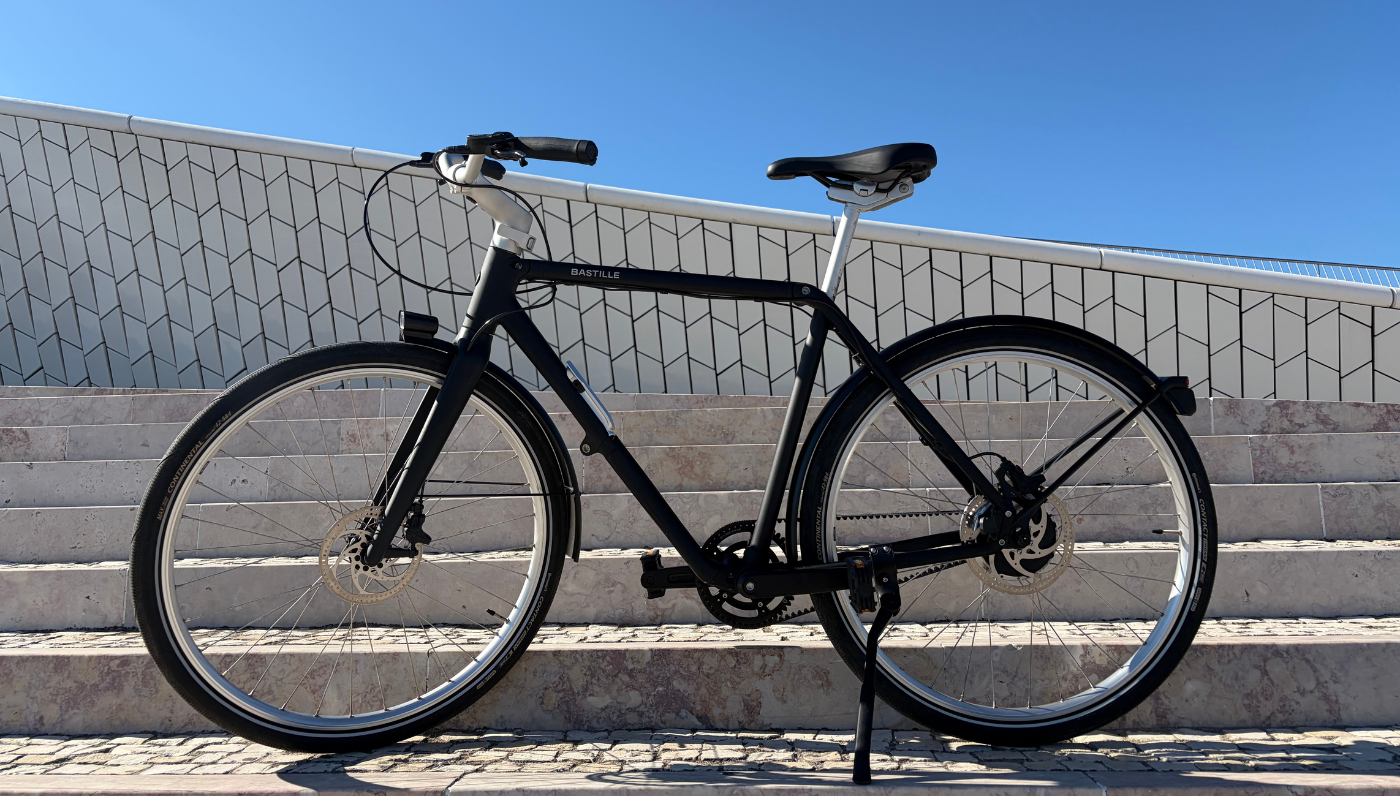
It rides low and forward, like a fixie, even on the raised bars the demo came with; there's a straight, flatter option too, lower still at the front. Where small folders get twitchy at speed, the Bastille tracks straight and holds its line, and the big wheels keep their momentum on the flats, smoothing out the Lisbon bumps.
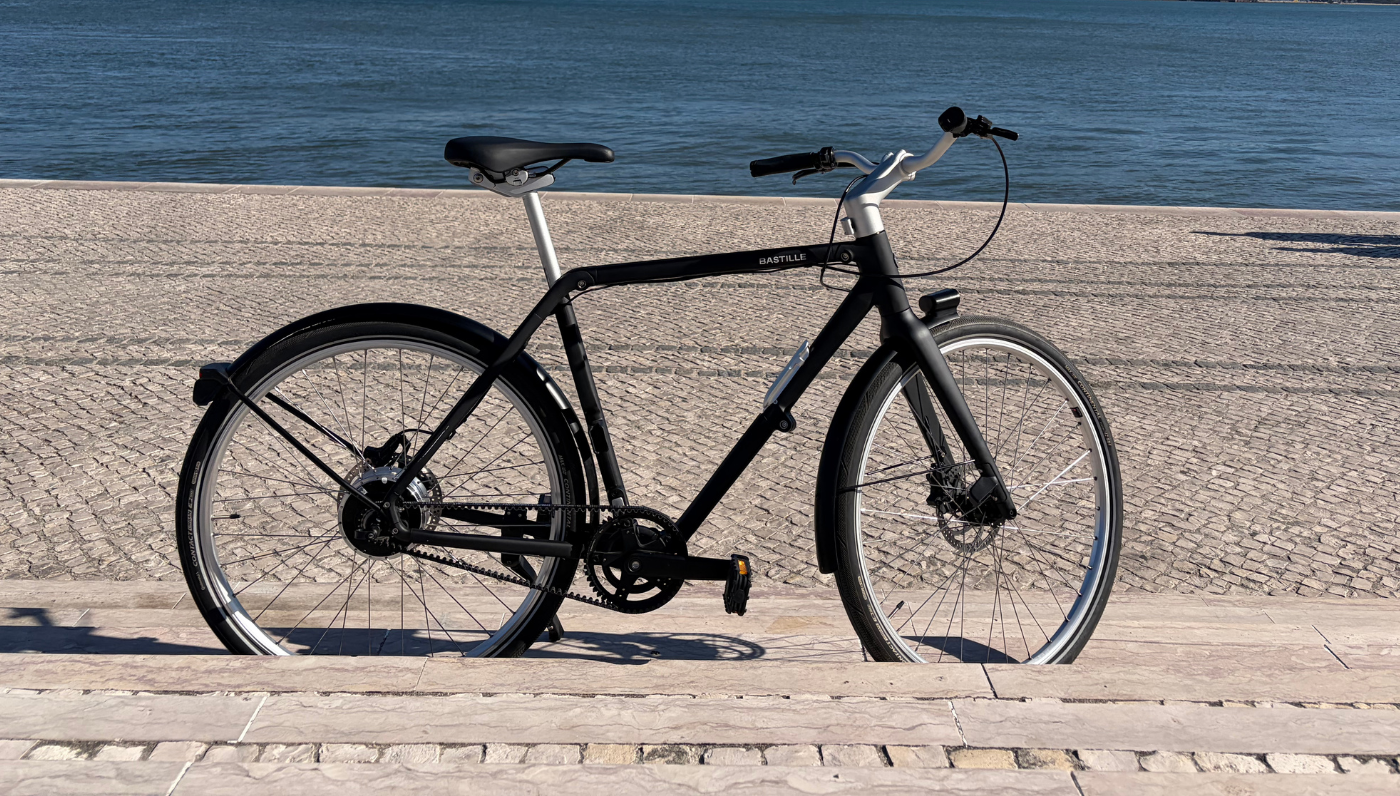
The kit is good. Most of it you'll recognise: a Gates belt, Continental tyres, Mach1 rims, Spanninga lights, a Shutter Precision dynamo up front, hydraulic discs. The lights wake the instant you pedal and, less usefully, won't switch off, so you ride with lights on at noon. The finish is stunning. Clean lines, the battery hidden inside the rear hub, bars and rims in a metallic grey keyed to the motor. It looks like neither a folding bike nor an e-bike. Though at 16.7kg it is not, whatever Bastille says, "light as air." But it is light for a fully equipped e-bike on full-size wheels, and with the motor, battery and controller all in the hub there's nothing to unclip and no charging brick to lose.
None of that mattered much for the first two months, because the bike couldn't climb well at all. Or so I thought.
This is the ride that nearly became the review. I'd come along the river from Santos towards Santa Apolónia, heading up to Graça to meet Kelcie for coffee. The flat riverside stretch is the reason you'd want this bike. Off the lights fast, a low hum of assistance, the intelligent motor giving exactly what my legs asked for. Then the road tips up at Campo de Santa Clara, and I was still in Eco, because I'd been in Eco along the water and hadn't given it a thought. Thirty metres into the climb the motor began to let go, until I was pushing sixteen and a half kilos of single-speed bicycle up a Lisbon hill. I thought of RC, the remote-control car in Toy Story, headlights dimming as his batteries fail at the roadside.
There is no button on the Bastille, and this was the first thing that really annoyed me about it.
Switching between Eco and Max depends on the app, which is fine until you realise you need Max halfway up a hill. Then you have to stop, get your phone out, open the app, wait for Bluetooth to find the bike, switch modes, put the phone away and start again. Starting a single-speed bicycle from a standstill on a Lisbon gradient is not much fun.
In the end I gave up and walked the steepest pitch of Santa Clara. Only from Copenhagen Coffee Lab up the last drag to Graça, in Max, did the bike do the job.
My notes from that week were fairly conclusive: lovely bike to look at, hopeless on hills, do not buy one if you live in Lisbon.
I didn't file those notes, and here's why. Six weeks in, the bike began to grind, then to fail outright. The motor would engage, hand over nothing at all, and cut out. What I'd read on Santa Clara as the bike's character was a hub in the process of dying. Nuno sent my video to the team in France and kept me in the loop. A new wheel arrived and I fitted it myself in ten minutes with ordinary tools, which is to the company's credit.
Everything electrical lives in that one sealed hub, the same design that keeps the bike design clean. So when the motor died, the fix wasn't simply sending a widely available battery. It was a whole new rear wheel, sent from France. Bastille describes the E as "easy to maintain and quick to repair, just like a classic bike," and that's fair for the bicycle half of it. Belt, brakes, tyres, any competent shop could service those parts no problem. Not the hub, though. That's a single proprietary box holding everything that can go electrically wrong There are 41 partner stores in France and, the company says, around a hundred across Europe by year's end. Mine was a used demo that had been round the block a few times before it reached me, so perhaps I was unlucky. But for the first quarter of a four-month test, I was reviewing a broken bike without knowing it.
It took a chance detour, a few weeks after the new wheel went on, to show me the bike I was meant to be reviewing.
We rode from Marquês down to Belém, took the ferry over to the beach, and came back to catch the boat at Trafaria, where we found an hour's wait until the next boat sailed. So we improvised, and pointed the bike up the N377-1 from Trafaria towards Monte de Caparica, planning to catch the tram down to Almada and the boat home from there. The clue, as I discovered, is in the name: monte is a hill. I braced for a second Santa Clara.
And it never arrived. There was effort in it, a decent workout, but the assistance stayed with me the whole way to the top, and I was in Eco. Up a long, honest drag of a climb, the bike simply pulled, and we were home in Marquês before the ferry we'd cycled away from had even left Trafaria for Belém.
So which was the real bike? The one that died on Santa Clara, or the one that conquered Monte de Caparica? Both. A dying hub made everything worse. The replacement gave me back the bike I should have had all along, and on the adaptive motor, in its single gear, it takes the sort of long, moderate climb a city is mostly made of without any issue. But there's a genuine ceiling too, and to its credit Bastille says so, tucked away in a motor-spec answer on its website, they say the E is "less calibrated" for pitches above ten per cent. Campo de Santa Clara ramps well past that. The road up to Monte de Caparica, for all its name, doesn't. The bike flatters almost any gradient you'll meet, right up to the wall, somewhere near one-in-ten, where a single gear and a small motor run out of road. In Paris you may never meet that wall. Riding in Lisbon, sooner or later, you probably will.
Strip the fault away and one real complaint is left: the app. Even with the bike back in perfect health, I can't get past the fact that you can't change assist mode on the move. In a flat city you'd hardly notice. You pick Eco at the door and never think about it again, which is exactly the "ultra simple" bike Henry says he set out to build. In the city he built it for, he managed it. Lisbon won't let you decide at the door. The gradient turns up mid-ride, four or five times a journey, and you rarely know which mode you want until you're in the wrong one. I understand why there's no screen. It would spoil those lines and give the fold something to snag on, and the bike is better-looking without it. But if the app is going to be compulsory, it might at least earn a place on the bars: a trip counter, some sort of gamification, built in maps. As it is, it's a settings menu you're forced to open at the worst possible moment, it’s like the light switch fitted outside the room.
There were other signs this is a first-generation bike with a second-generation finish. The fold works partly by letting the steering column swing through ninety degrees so the bars come away from the wheel. Early on, before the wheel swap, I turned the bars at low speed and they rotated while the front wheel stayed pointing dead ahead. For a second that is properly frightening. A bolt in the housing had worked loose. Once tightened it never recurred, but it's not the sort of thing that should come loose on a €3,190 bicycle, and it left a doubt I never quite shook. The pedals are small plastic things that flex under my size 46s. The bike is built for riders from 1.60m to 1.90m. I'm at the top of that, and it shows. And the bar choice you make at checkout, flat or high, is your lot. No adjustment after.
Run down the spec sheet and Bastille names everything. As mentioned, the belt is Gates, the tyres Continental, the rims Mach1, the lights Spanninga, the front dynamo Shutter Precision. Bastille has packed great components into the product. Yet, the motor, controller and cells sealed inside that rear hub are Bastille's own. Part of what you pay for with a Bosch or Shimano system is a known name behind the battery and the service network that comes with it. At this price, and after the failure I had, that's the omission I'd most want closed. The battery is 210Wh, and Bastille's own figures now put the range at up to 50km in Eco and 40 in Max. Fair enough on the flat, though lean on Max in the hills and it's nearer a couple of short return commutes on a mixed route before it needs to be hooked into the wall. This is fine for most people. Pack the charger and plug it in everyday in the office. For me, a bigger cell, and a named one, would make it that bit more worthy of the price tag.
Bastille sells the E direct from its own site at €3,190, shipped free in about a week. It comes with a two-year warranty and a fourteen-day return window. There's a reconditioned version from €2,590 as well. Past that it relies on a network of partner bike shops for test rides and servicing, and that's what turned my six-week hub failure from a nuisance into a fortnight's wait. The network is, for now, overwhelmingly French. Live where the shops are and the direct-plus-dealer setup is genuinely reassuring.
The obvious rival is the Brompton Electric, and the two suit different lives. The Brompton folds far smaller and is the better bet for a packed train or a shoebox flat, but it rides on 16in wheels. The Bastille folds bigger and rides like the full-size bike it is. Want the smallest possible bundle? Buy the Brompton. Want ride quality with a fold that still tucks into a hallway? Nothing else does what this does. The big American folders, Lectric, Velotric, Ride1Up, beat it on every line of the spec. Cheaper, more powerful, geared and far better off for range. But they're heavy and small-wheeled.
For two months I was ready to give it three stars and be done with it. Lovely to look at, can't climb, not for this city. I'm oddly glad the hub failed when it did, because the bike that replaced it climbs Monte de Caparica in Eco and beats the ferry home. It doesn't climb everything. Somewhere near one-in-ten the single gear and the small motor bow out, and Bastille admits as much. But that ceiling clears the honest gradient of most journeys, and the walk up Santa Clara was a dying hub, not the shape of the bike. That it took a catastrophic failure to show me the real machine still counts against it, and a sealed hub with an unnamed battery inside turns any fault into an expensive, opaque one, the more so the further you live from France. But whole and healthy, this is about the best folding electric bike I've ridden.
Over ten years, three patents, and something no other brand has pulled off. It wants one button, a bigger and better-named battery, and a second-generation going-over on the small stuff. Give it those, and I'd recommend it in any city, flat or hilly.
.png)