

In partnership with Tracksuit. Data provided by Tracksuit; interview and analysis led independently by THE GOODS.
LONDON — In 1935, if you wanted to sell something to do with the gut, New York's Madison Avenue had a formula for it. Stomach tonics, digestive bitters, and "scientific" cure-alls packed the pharmacy shelves and the radio spots. Across the pond in London, Bovril and Horlicks were household names, marketed on the promise of inner fortitude. Consumer culture in both cities had learned that health anxiety sold, and digestion, reliably, was where that anxiety lived.
On the northern littoral of Kyushu, the southernmost of Japan's four main islands, a place of volcanic coastline, a scientist named Minoru Shirota, working out of Fukuoka, was doing something different. He had spent years cultivating a strain of lactic acid bacteria resilient enough to survive the full journey through the human digestive tract to support the conditions for ordinary good health.
He called it Lactobacillus casei Shirota.
The intellectual lineage of the discovery runs further back: as a student at Kyoto Imperial University, Shirota had been struck by the work of Élie Metchnikoff, a Nobel Prize-winning Russian biologist who in 1900 had published a paper on the exceptional longevity of Bulgarians, attributing it to their habit of drinking fermented milk.
Shirota believed that good health should not be a luxury. His first distribution model? Selling Yakult house to house.
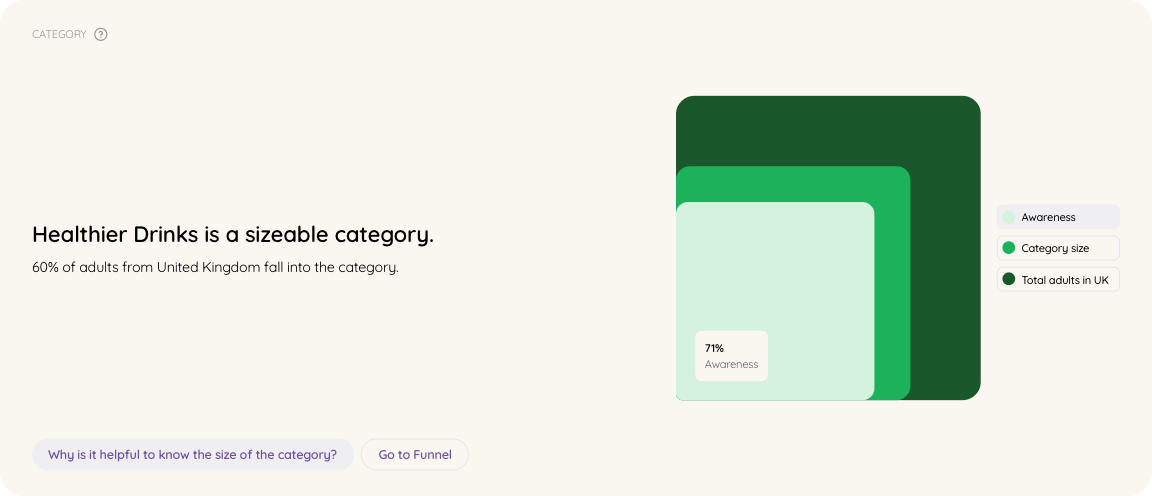
Nearly a century later, gut health has become one of the most commercially active and intellectually contested spaces in consumer health. According to Tracksuit, 60% of UK adults now participate in the Healthier Drinks category, a category that has expanded well beyond digestion to encompass immunity, mental wellbeing, sleep, and longevity.
And through all of it, the small red-capped bottle has remained.
The bottle itself, with a distinctive hourglass form (easy to grip for both children and elderly hands), was designed to slow the pour and encourage sipping. Developed in 1968 by Kenmochi Design Associates it has barely changed since. In packaging terms, that kind of continuity is almost unheard of. The Coca-Cola contour bottle is the standard comparison.
That said, the brand has not stood still. In 2023, Yakult refreshed its full UK range and Yakult Light was renamed Yakult Balance across Europe, packaged with updated labelling that put flavour profiles and nutritional benefits more legibly front and centre. Yakult Plus launched in April of that year with new vibrant green branding, adding vitamin C and fibre to the existing probiotic formula. The label design across all three products was updated evidence of the brand’s thinking seriously about how it shows up in a much more crowded aisle than the one it created.
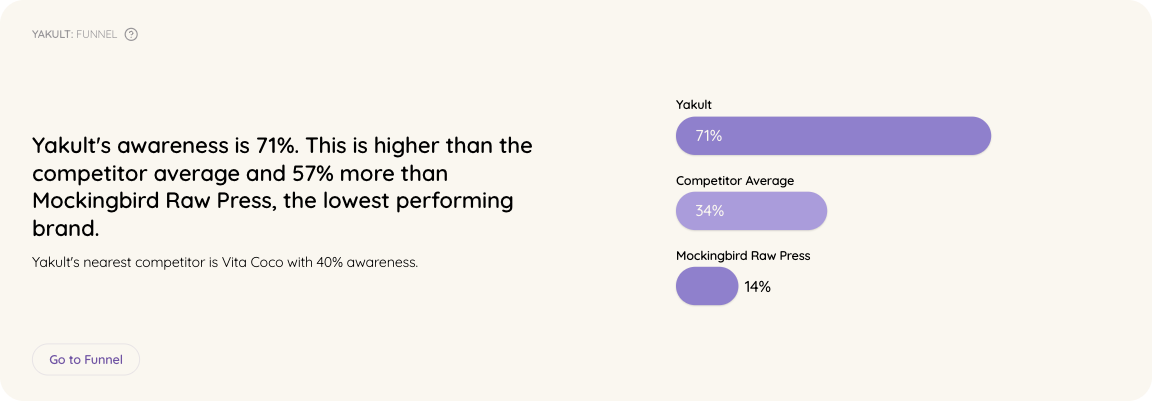
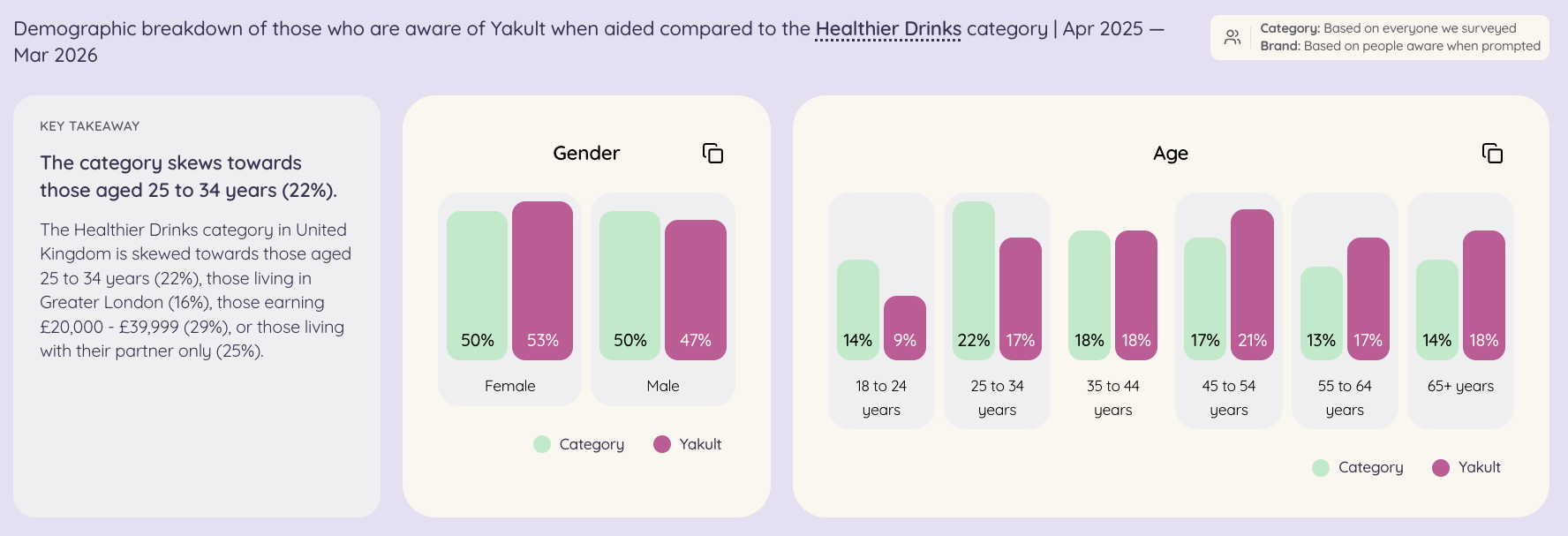
According to brand tracking data from Tracksuit, Yakult's aided awareness in the UK sits at 71%, nearly double Vita Coco, its nearest competitor, and far above the category average of 34%. At 29%, Yakult's preference score is almost three times the competitor average of 11%.
Shinji Yamaguchi is the man now charged with building it. Appointed Managing Director for Yakult UK & Ireland, Yamaguchi came to the role having helped establish Yakult in the United States. Before that, a career spent moving through the organisation, starting, memorably, at the door. On home deliveries meeting consumers face to face, one by one.
That trajectory, shapes how he thinks about trust, attention, and what it takes to build something people keep coming back to.
When we speak, he is still relatively new to the UK, learning the market with the same curiosity he brings to photography on the weekends: looking for all the small details that give a place its character.
Talking about Yakult one-to-one with customers gave me a strong foundation in customer relationships and an understanding of how people make decisions about their everyday health habits. Home delivery taught me the value of frontline communication, trust, and how genuine customer connections create long-term value.
It also showed me how important it is to stay close to real life, what people actually care about, what they'll realistically keep up, and what makes them feel understood rather than sold to.
In a busy and often complex landscape, the gut health category is expanding beyond digestion to include immunity, mental wellbeing and overall long-term health. Yakult best serves consumers by offering products that are easy to understand, that people can incorporate into their daily routines, and that are backed by 90 years of heritage and science.
As a category pioneer, Yakult will continue to lead by remaining firmly grounded in science — offering products and information supported by decades of research and clinical evidence. We are closely monitoring the shift from quick-fix solutions toward preventative, sustainable and credible approaches to health and wellbeing, which aligns strongly with Yakult's long-standing scientific philosophy.
Rather than focusing on how crowded the category has become, I see it as a reflection of growing consumer awareness and interest in the relationship between the gut and wellbeing. It also reinforces the importance of providing accurate, science-based information, and building trust in a way that supports long-term understanding rather than short-term interest. We don't chase trends. Our focus remains on supporting the underlying building blocks of long-term health.
What hasn't changed is that people want to feel well and live happily — and good health is a big part of that. They're drawn to choices that feel practical, credible and easy to keep up over time.
I believe over the next thirty years, the world will keep getting noisier and faster, but the brands that last will be the ones that stay consistent. The ones who are clear about the value of their heritage — including the previous 90 years of Yakult science — and can see that heritage moving forward in a continuing programme of science and development that will recognise and adapt to the evolution of understanding of gut science over the next decades.
One of the toughest challenges in my career was introducing Yakult to new consumers when the idea of "good bacteria" was unfamiliar. At the time, the feedback we often received was scepticism — because bacteria had a negative reputation, so there was real resistance at first.
But little by little, by showing up consistently, explaining the science in simple terms, and letting people taste the product, we could feel trust forming. What stayed with me most was hearing directly from consumers and seeing that feedback change, with letters saying they wanted to buy Yakult and that it genuinely helped them.
It reinforced a leadership lesson I still rely on today: that trust is earned through patience, clarity and consistency. Those experiences also reinforced the importance of listening and staying close to customers and partners — which is exactly what I want to focus on in the UK now.
In the United States, what surprised me most was the huge scale of the different products, messages and trends consumers are expected to process at once. It's also a country of distinct regional markets, with major centres in every region, which has a real impact on distribution strategy and how you build awareness. It's a market where attention is hard-won and narratives move really quickly.
That experience applies strongly to the UK: while the markets are different, the challenge of earning attention is the same. This reinforces how important clarity and consistency are in helping people build everyday health habits.
Consumers in the UK and Ireland are highly health-conscious and increasingly seek credible, evidence-based guidance and solutions. This presents a strong opportunity for Yakult to reinforce its position as a reliable and accessible brand. The biggest opportunity lies in positioning gut health as a really important part of everyday self-care, rather than something to think about only when issues arise, so encouraging the development of long-term habits.
To deliver that, we'll keep strengthening consumer engagement, collaboration with retailers and healthcare professionals, and responsible communication of scientific information, so we stay clear, relevant and trustworthy in a crowded landscape.
We want Yakult to remain a brand that is trusted across generations. By continuing to support everyday health through the gut, we aim to be an enduring part of people's lives for many years to come.
In Japan, we have a word — Aichaku 愛着 — meaning a sense of warm, lasting attachment built over time. My aim is to grow Yakult not only through trust, but through that deeper connection. Building a brand that people genuinely feel close to and choose as part of their daily routine.
When I step away from work, I like simple routines that reset me. I practise Aikido at my local dojo, and I also love walking with a camera, especially street photography, because you start noticing the quiet details that give a place its character.
In the second half of 2026, I'm hoping to explore much more of the UK and Ireland, as I've only relocated recently.
I wouldn't say I have one particular favourite restaurant. I'm more drawn to the overall atmosphere and experience of a place. In the UK, one of the things I most look forward to is dining at different gastro pubs. From Sunday roasts to fish and chips, I enjoy how flavours and styles vary from pub to pub, and that diversity is part of the enjoyment.
I'm also impressed that it's not only the meat or fish dishes that stand out; many pubs put just as much care into their vegetable dishes, which can be truly exceptional. I really value those kinds of discoveries and the unexpected pleasure they bring.
It’s probably too early for me to claim a single favourite pub, but one I always enjoy visiting is The Hound in Chiswick. When I was in Tokyo, I often visited Kuwabara Shoten, a family run, Japanese style pub in Gotanda. The staff are incredibly friendly and welcoming, and they serve comforting, homestyle dishes that make it a really pleasant place to spend time.