
In paid partnership with Tracksuit. Data provided by Tracksuit; editorial control by THE GOODS.
LONDON — A week after Monzo officially launched in Ireland, its first market outside the United Kingdom, entered on the back of a 100,000-strong waiting list, the company's Chief Design Officer is sitting across from me with a cup of coffee. "I'm not really a morning person," Vuokko Aro says, and apologises for being two minutes late. "And it's such a busy moment right now. Everything is happening at once in addition to a house renovation." A pause. "All good stuff, though."
The "all good stuff" is doing a lot of work. In the financial year ending March 2025, Monzo reported a 48% rise in revenue of £1.2 billion and pre-tax profits that multiplied eightfold. More than two-thirds of new customers arrive through word of mouth.
And Aro has been, in part, responsible for how all of this looks and feels, her team counting majorly toward deepening consumer trust. Every pixel, every screen, every interaction has been part of Aro’s everyday for almost nine years.
The bank is now the largest digital bank in Britain, with 15 million customers, including over 800,000 SMEs.
According to brand tracking data provided by Tracksuit, Monzo leads the digital banking category at every stage of the consumer funnel, ahead of both competitors Revolut and Starling Bank.

In Personal Banking, the picture is more competitive. Looking at usage over time in personal banking, Monzo has grown from 11% in Sep 2023 to 16% in Feb 2026. While Barclays and HSBC remain the clear category leaders, preference trends suggests Barclays has declined from 25% to 18% over the same period, while Monzo has held steady at 7%, signalling there is preference share to compete for as legacy brands soften.

The launch in Ireland is the first step of a Europe-wide expansion. Aro joined Monzo in June 2017 as one of three designers, when the entire company was under a hundred people. She has been promoted four times since, most recently to Chief Design Officer in November 2024, and now leads a team of more than 120. Aro has worked on all things Monzo: The hot coral debit card, the spending notification that arrives before you've left the shop, the drag animation that celebrates when your salary lands a day early. The small, deliberate details that make Monzo feel like Monzo.
Aro’s drive, focus and intellect is immediately noted. And yet, alongside that drive is a very human, self-aware individual that Aro harnesses powerfully to lead. To lead in a way contrary to a manager she encountered early in her career.
This manager told Aro, repeatedly, to be more like this colleague or that colleague. To be less like herself. Had she listened, perhaps this story may have been completely different entirely. More on that later.
The launch campaign for Monzo Ireland, created by BBH Dublin and titled It's About Time, ran across five short films set over five decades of Irish life. Characters by phone boxes, watching screens load, standing in the familiar inconvenience of the everyday. Voiced by Siobhán McSweeney, Derry Girls, Traitors Ireland, it balanced nostalgia with a sharp contemporary tone.
At Smithfield Plaza in Dublin, a hundred people stood together on a giant Monzo card installation and waited for a countdown. Those who stayed were rewarded with €400 Golden Tickets deposited directly into new accounts.
Credits: Brand: Monzo. Agency: BBH Dublin. CCO: Alex Grieve. Executive Creative Director: Felipe Serradourada Guimarães. Creative Director: Gary McCreadie. Director: Daniel Liakh. Production: Chaser. Voice: Siobhán McSweeney. Media: Core.
The campaign's argument was that banking has kept people waiting long enough. It is in essence the marketing version of what Aro's team has been making inside the product for years.
I joined from prepaid card times. There were three designers when I started, and the whole company was under a hundred. Now my team is bigger than the whole company was when I joined. I feel like we've scaled the good parts but been able to leave some of the growing pains behind. The culture, the good parts, are still there. The product and brand vision, what we're aiming for, we've been able to keep it.
It took me a while. Twenty-plus years ago, there wasn't a clear path into design. There was graphic design, industrial design, a lot of cool professions, but they seemed scary and niche. Would there really be space for me?
I was always creative. I had artistic hobbies, I would design shirts for my friends. But I didn't know it was a real job. This was before iPhones and apps and all the modern things that elevated what design actually is.
So I studied economics. I went to business school. It left a lot of doors open. A good generalist starting point for understanding what everyone else in a business does. Then I was a reporter, then I had this path through copywriting and concept design, gradually moving towards actual design. I went back to school for it. It was very much a gradient. There wasn't one day I wasn't a designer and the next day I was.
I think it made me stronger. There are parallels between economics and design I didn't see until later. You think about systems, there are a lot of rules, and you have complex concepts
that need to be visualised. That's actually what drew me to economics in the first place, all the graphs and rules. Now I can see how directly that maps to design.
A lot of design leaders advance in their careers and then go and get a business degree. I'm the other way around, business first, then I became better and better at design.
I start with the realities of the business. What are we trying to achieve? What do we need to do compared to others in the market? Where are we as a team right now? That's the constraint. And then that lets me go wild with creativity within that frame. I think it's helped me solve for what a business is actually trying to do, rather than trying to apply design to it afterwards.
Design is wider than product. At Monzo, it spans the full experience, from interface to brand to how the company speaks to customers.
I'd moved around a lot by then, Helsinki, New York, London, and I'd worked in media, sports, transport. CityMapper before Monzo. At that point, about nine or ten years ago, I felt like everyone needs design, and I'd found enough of a groove that it didn't feel risky.
What pulled me to Monzo specifically was the ambition. The founders had decided to start a bank from scratch and disrupt the industry. I really believed in it. I thought: this needs to happen, and this is a group that can do it.
It's quite rare in tech to stay anywhere as long as I have. But I also didn't feel the itch. My role has grown and changed so much. Even if technically it's always been the same, working across brand and product, it just keeps feeling like a different company.
I optimised early on for interesting learning experiences. I made sure I was always somewhere I kept learning. I'm still growing at Monzo. That's why I'm still there. It kind of can't go wrong when you're improving as a designer, whatever happens after.
I got feedback along the lines of: you need to be more like this person, or that one. And I think it made me feel like I would have to be fundamentally different to make it. That was very unhelpful.
I'm really self-reflective, so sometimes I reject feedback in the moment because I feel like I've thought about it myself already. But then I listen, and I reflect, and I take it in over time. In this case, the taking-in went in the wrong direction. I think there was probably a history of that feeling, maybe internally I'd convinced myself I should be something different.
Five years ago, yes. I had an amazing manager who helped me understand that I don't need to be like everyone else. She really helped me see that I could lean into what I'm uniquely good at, what I uniquely bring. That gave me a lot of confidence, to just do that, a lot more.
She saw the potential of me bringing what I do, and what it could do for the business. She wasn't trying to fit me into a template.
It kind of unlocked something. I was doing my thing before, but it just really supercharged me. I feel like it put me on a whole different trajectory in my entire career.
I'm lucky to have had someone like that.
No. They stick with the other feedback.
It’s worth pausing here. Tracksuit data suggests that, in the broader personal banking category, HSBC, Barclays, the incumbents, the strongest driver of why a UK consumer chooses Monzo is not “reliable,” “innovative,” or “good rates.” It is “is for people like me.” The association carries 3.5x the importance as a driver of consideration, and rose five points last quarter, the biggest gain in the category.
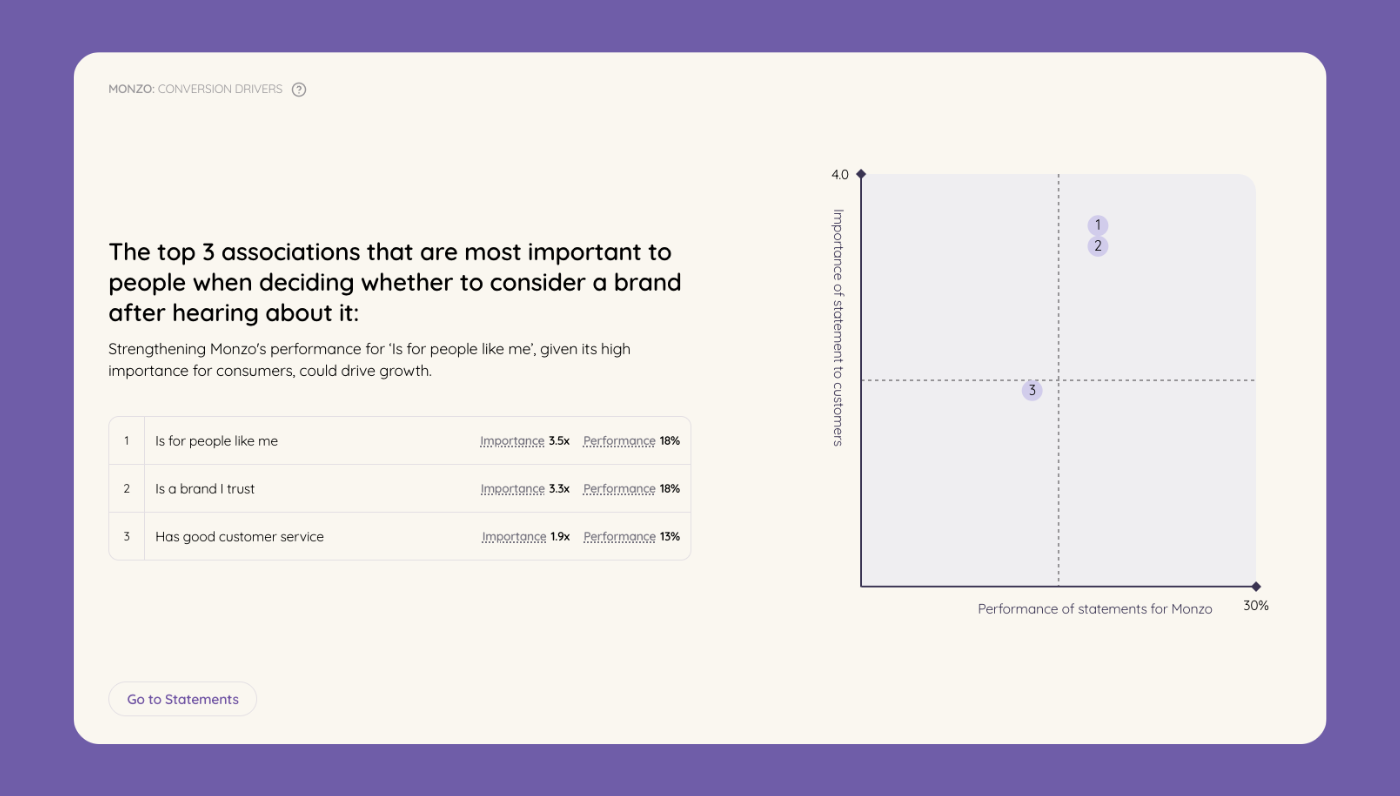
Which is to say: Monzo’s growth runs on a simple feeling, that the bank was made for the person holding the phone. That is what Aro and her team have been designing for nine years. It is also, if you take her at her word, the feeling she had to find for herself before she could build it for anyone else.
We know that payday is the best day of the month for most people. So for our Get Paid Early feature, which gives customers their salary a day early, we've created a drag interaction and an animated celebration. Just to help savour that moment for a few seconds.
As a bank that lives on your phone, how the app looks and feels really matters. So we obsess about bringing what we call Monzo Magic to every interaction. It sounds small but it's very deliberate. Attention to detail is how you build trust. Not on a spreadsheet. In the actual experience of using something.
Consistency is huge, it really does build trust. Attention to detail, on every level. The quality customers see and interact with is a really good indicator of quality all the way through, down to the parts they can't see.
We're genuinely obsessed with learning from customers, understanding how they use our products in real life. That's why we have a big research team and lots of different ways to talk to people and get direct feedback. Ultimately that adds up to a product that's designed for people's lives in a way that actually means something.
And it seems to be working. Trustpilot scores Monzo 4.6 out of 5.
For years I've been passionate about our design team culture and our community of craft. I truly believe it helps if everyone gets to know their peers as people first. It makes it so much easier to collaborate, share ideas, and actually challenge each other when it matters.
What still surprises me is that we've managed to scale that from a team of twelve, five years ago, to over a hundred people now. And it still feels like ours.
Beyond the design team, I've put a lot of effort into building a wider appreciation for design across the whole organisation. I want people to understand design as a process, to see everything that goes into creating something that never existed before.
In Design Week in 2024, Aro explained that design “can’t just have a seat. It needs a voice.”
It comes down to trust, and to showing how your early input as a designer benefits all disciplines and ultimately delivers better products for customers.
Part of how Aro earned that voice was by writing ‘vision papers, internal updates, explanations of what design was doing and why it mattered.’
What we've been able to build at Monzo is a shared high bar for delight and user experience across the whole company. People can think more like a designer even when designers aren't in the room. It's not all me or my team anymore, the whole business is making human-centred decisions in a way a designer would. That's when you know it's really working.
We're all learning at the same time because everything's changing so fast. No one has a head start when it comes to tooling. Claude Code has gotten so good in the last three months. Even if you had been using it for a year, it's just changed so much.
A few things will never change. The fundamentals: colour theory, layout, universal design principles, how human minds and eyes actually work. Whatever the tools do, those don't move. They're about human brains and eyes.
And then the apprenticeship model. This might be old-person advice, but it works. I levelled up many times in my early career by literally sitting next to someone making amazing design decisions and watching how they worked. I worry that with remote jobs you're not as exposed to other people's process and thinking. If you're able to be immersed in the work of someone who already does it really well, that's a real level up. So you need to be deliberate in how you connect and encourage learning from each other.
What is striking about Aro in person is how matter-of-fact she is. Perhaps it's down, in part, to her Finnish roots, or the humbling experience of 'being the odd one out since being a little Finnish kid growing up in a foreign country (the US)', and channelling that different perspective in creative, constructive, positive ways back into the world around me.'
And yet, Aro has been promoted four times in nine years, holds two master’s degrees, and has moved countries more than once to follow work that interested her. The word she comes back to is “lucky.” Lucky to have had the manager who told her not to try to be someone else. Lucky to have joined Monzo early. Lucky to have sat next to people and learned how they worked. She talks about the team, the founders, that one manager - not herself. And it's rather endearing.
The title feels incidental to how she explains the job. Her advice to younger designers. Learn the fundamentals. Sit next to people you can learn from. Keep going. Enjoy the ride.
Out in the sun somewhere. Swimming, or photographing a city I've never been to before.
I love how Nothing is refusing to make the same boring phones as everyone else. The glyph interfaces on the back, a genuinely new idea. Our phones are some of the most-used objects in our lives. It's high time we got some fresh thinking in that space.
I find myself most inspired by creators and environments that treat art as a living extension of its surroundings.
To me, the most powerful work doesn't just sit in a space, it exists as a part of it and the two evolve together. I adore that sensation where art and the natural world enhance one another so seamlessly that you can no longer imagine one without the other.
For example, I really love places like Fondation Maeght that feel like a complete world within their surroundings.
I also seek out places with majestic scale: the Utah desert, the Alps, and other places that evoke a sense of awe, helping me escape the everyday and zoom out.
When it comes to exhibitions, there are many artists and exhibitions to mention, but if I try to pick one, I really loved the scale and power of Kerry James Marshall's paintings at the Royal Academy this past winter.