
In partnership with Tracksuit. Data provided by Tracksuit; interview and analysis led independently by THE GOODS
NEW YORK - In Lund, winters are long and daylight is rationed. At the city’s university, food scientist Rickard Öste developed an enzymatic process that transformed oats into a beta-glucan-rich liquid, conceived as a practical response to lactose intolerance, years before it would line the shelves of specialty cafés from Copenhagen to Panama City.
That starting point is easy to overlook.
Somewhere between my first decaf flat white of the day, steamed by Jason, (currently Ozolotepec EA Decaf - washed Mexico) and a later pour into my Le Creuset mug of Yorkshire Tea decaf, I rarely think about the enzymatic process in Sweden that made it possible.
Three decades later, Oatly operates in a category far removed from its niche origins. According to brand tracking data from Tracksuit, 57% of U.S. adults now participate in dairy & milk alternatives. What began as a substitute is now routine grocery behaviour.
At the same time, the category remains legally contested. In February 2026, the U.K. Supreme Court has ruled that Oatly can no longer use its “Post Milk Generation” trademark, reinforcing that dairy terms such as “milk” are reserved for animal-derived products.
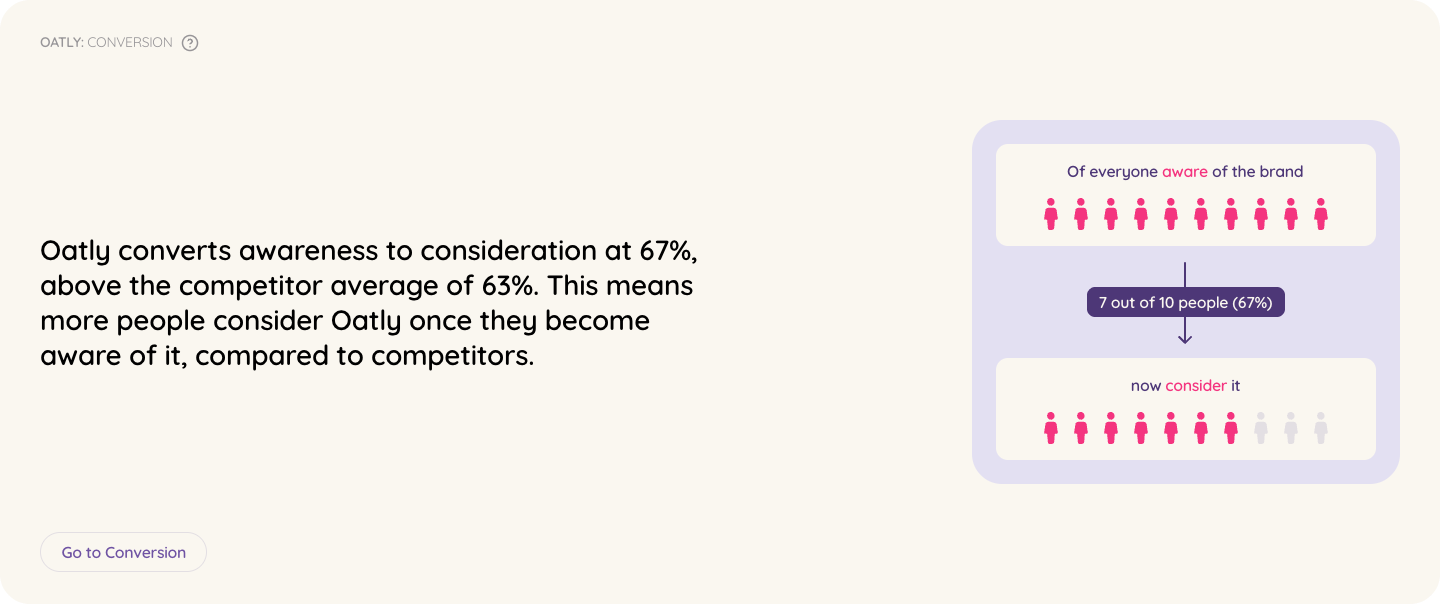
In the U.S., according to Tracksuit, Oatly’s aided awareness sits at 31%, placing it directly on the competitor average. It trails category leaders such as Silk, yet remains comfortably ahead of smaller plant-based entrants. Where the brand strengthens is in conversion. Sixty-seven percent of consumers who are aware of Oatly go on to consider it, outperforming the category average of 63%.
In North America, Yasmin Shahida sits between brand, culture and competition. When we speak over Zoom, she is between meetings, about to head into a session with the ODMC - Oatly’s in-house creative department - where creative direction takes shape.
Shahida built her career inside organisations under sustained public scrutiny, where media narratives moved quickly and control was rarely guaranteed. At CBS News, she worked across the national desk and evening broadcast, learning how quickly a story hardens once it enters the public domain.
At The Wing, she was part of the communications leadership during one of the most closely watched corporate reckonings of the past decade. She later led Communications & Corporate Affairs at Away during a pivotal moment in the company’s evolution.
That background informs how she operates at Oatly, which does not follow a conventional marketing structure. There is no traditional marketing department. Communications is embedded within the creative engine, the Oatly Department of Mind Control (ODMC).
Shahida is part of that group, involved early, often at the point of ideation, rather than brought in once a campaign is finished. Product launches, retail partnerships, barista collaborations: the communications lens is present from the outset. As she explains, the difference is being in the room before the idea is fully formed, not after it is ready for amplification.
Our conversation explores how Shahida thinks about balance, from coffee culture and fashion partnerships to GLP-1 debates and fibre narratives, and what PR can realistically influence when awareness is no longer the constraint.
I think there’s often this misconception that things can be fully formulated with a specific team. I see this with marketing teams. They’ll spend months and months working on an idea, a big campaign, and then they’ll bring it to the PR team and say, “We want to get press coverage. We want to make this a big moment for the brand.”
The misconception is that when you’re not incorporating a strategic PR thinker from the onset of the conception, it’s automatically translatable into PR coverage. Something has been fully baked and brought to the PR team, and then the PR team is told, essentially, “We feel so passionately about this, how can we get coverage?”
When PR is incorporated from the beginning and is part of that ideation phase, we’re in the room as strategic partners saying, “This is a topic of conversation that is happening in the news. This is a way we can tie what we’re doing into the cultural conversation.” That gets lost when executives or team members don’t incorporate a strategic PR thinker from the early stages.
We pioneered the modern oat milk category, and the cultural conversation has since shifted repeatedly, from nutrition to climate to the debate between dairy and plant-based. We’ve been part of each cycle.
Something I’m seeing right now that is really exciting is that at the foundation of what Oatly has done is create strong relationships within coffee culture. What’s happening right now with coffee is that it's become a cultural phenomenon. Drinks are now the main character in culture. Young people treat drinks as accessories. Little treat culture.
Oatly is synonymous with drinks culture. Drinks are bleeding into fashion. You see fashion brands opening coffee shops. We have a Coach cafe here. We have a Louis Vuitton cafe. Music—celebrities doing signature smoothies. What’s amazing is there’s so much opportunity. Yes, we’re a plant-based product, but we’re also a product for everyone. Folks have Oatly in their fridge who are not choosing it because they need a non-dairy alternative. They’re choosing it because they love the taste.
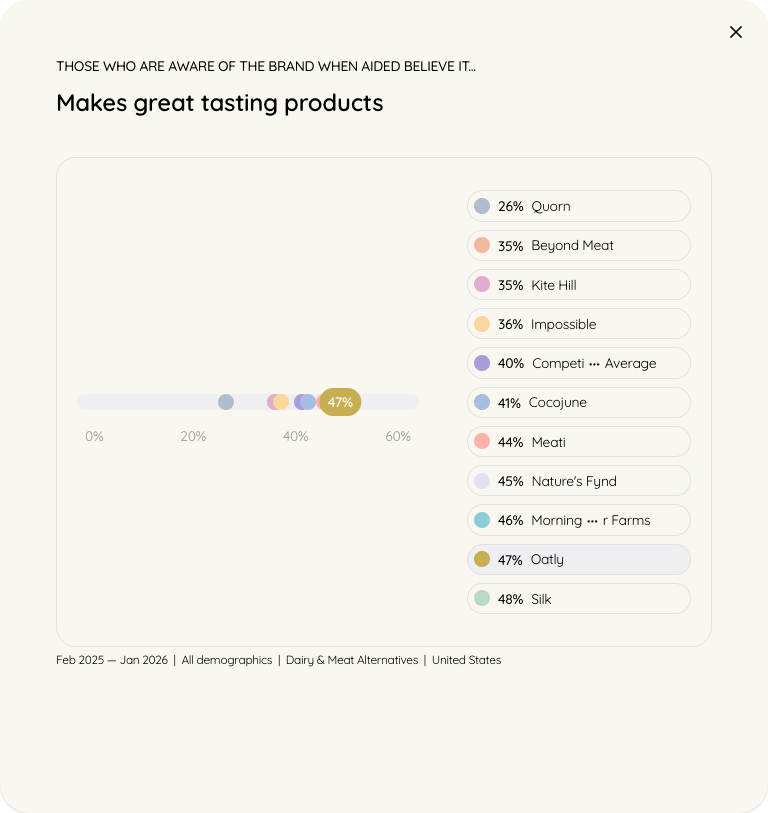
And data from brand tracking firm Tracksuit, agrees: Forty-seven percent of those aware agree the brand “makes great tasting products,” outperforming the competitor average and several plant-based rivals. Taste remains its clearest advantage.
Shahida continues:
We just did a barista work wear capsule collection. We partnered with a street wear label to launch a collection designed with baristas and for the barista community. Cosmetics and beauty brands are constantly coming to us because there’s this whole culture of milk cleansers and incorporating oats into skin care routine.
%3Aformat(webp).webp)
There are these things happening, but it’s almost like those aren’t even the main focus for us. The focus is momentum around what’s happening in culture with beverage as the anchor point.
When people feel a personal connection to a brand, it drives loyalty and retention. Oatly has built that kind of loyalty. We’ve never shied away from taking a position — including challenging big dairy. There are moments of pushback, of course. In the U.K., we can’t use the word “milk.” In the U.S., that line has not been drawn.
Right now, the bulk of our focus is on our core assortment of products - Barista, which is the number one choice in coffee shops, and original. We have an unsweetened product. We have a super basic product - four ingredients. We have flavoured baristas. There’s a matcha product we launched in the UK.
We have a team of 60, we call them BMDs, Barista Market Developers. Their job is to stay in close contact with specialty coffee shops. They host events. They work on limited edition drinks. If a new coffee shop opens, they’re at the door.
Through that network, we’re able to aggregate insights and data that becomes valuable for commercial partners. It informs product assortment. We have things coming out that are flavors you’ve never even imagined. Those are direct results of insights we’re seeing.
When we partner with a grocery store or a quick-serve restaurant, we’re not just coming and saying, “Here’s our Oatly.” We give them insights into what Gen Z is drinking, how they can innovate on their menus, and how we can do creative things from a brand marketing perspective. That level of insight provides so much value.
There’s been this obsession with protein in the United States - protein maxing. The interesting insight is that most human beings are getting plenty of protein. Where we are at a deficit is with fiber.
Fiber is at the foundation of Oatly’s products. We use whole oats, which means we have the beta glucans. Fiber is very important when you talk about GLP1s because people are dealing with digestive issues where they need to be eating more fiber. Our product can help people fill that fiber gap in their diet.
Being open and honest with your employees is number one. Your employees should feel connected to the brand the same way consumers do. They’re essentially ambassadors and you want them to feel like they can trust leadership and there’s insight into what’s happening. That level of transparency is really important.
Without that, there are opportunities for miscommunications, issues to arise, for people to feel disappointed with what they’ve been told versus what the reality has been.
In PR, in a crisis moment there’s intensity coming your way. You have to take a step back and separate yourself from the equation. Otherwise it’s going to eat away at you. Someone saying something accusatory, it’s not an attack on me. Maybe it’s an opportunity to shine a light on something we could be doing better.
Companies that learn from those moments and use them as opportunities to grow rather than sticking a band-aid on it and saying, “How can we spin this story?” are the companies that build long-term resilience.
My personal superpower is translating taste and culture into brand relevance. I’m the head of PR for North America, but I sit on the creative team. We don’t have a traditional marketing team. We have a creative team called ODMC: the Oatly Department of Mind Control.
ODMC is embedded into everything that we do - relationships with commercial partners, pitching a new retailer, anything on the executive team side. Being able to bring a real pulse on what’s going on in culture and translating that into making the brand relevant, that’s the connector. We do a lot of awesome fun things that I don’t think we get enough credit for.
Connecting the dots between what we’re doing and how that leads to relevance, and in turn generates real business outcomes, that’s a lot of the value that I provide.
I live in Brooklyn. The coffee shop that I am currently obsessed with is called Maru Coffee, which is actually an LA coffee shop that recently opened in New York. It is my favorite spot right now. Incredible coffee. The vibe is so serene. It’s my happy place every morning. The team is wonderful. And they use Oatly.
Because I work mostly from home, when I go shopping I like to invest in something a little bit more longstanding. Ganni would definitely be one that I love. For basics, I really like Reformation.
Instagram is definitely one of my most used apps. I have a personal Instagram outside of my work from Oatly, a food Instagram where I do restaurant reviews and food reviews. I share cooking, travels, and itineraries. My handle is @traveleatnyc.
The Substack app. I love Substack. I read Emily Sundberg’s Feed Me every single day. I read Rachel Carton’s Link in Bio. Casey Lewis’s Substack. It’s part of my morning and evening routine.
In regards to travel, I just went to Brazil at the beginning of the year, and I’m going to Peru in a couple months. It’s a big South America year for me.
This interview has been lightly edited and condensed for clarity.
.png)